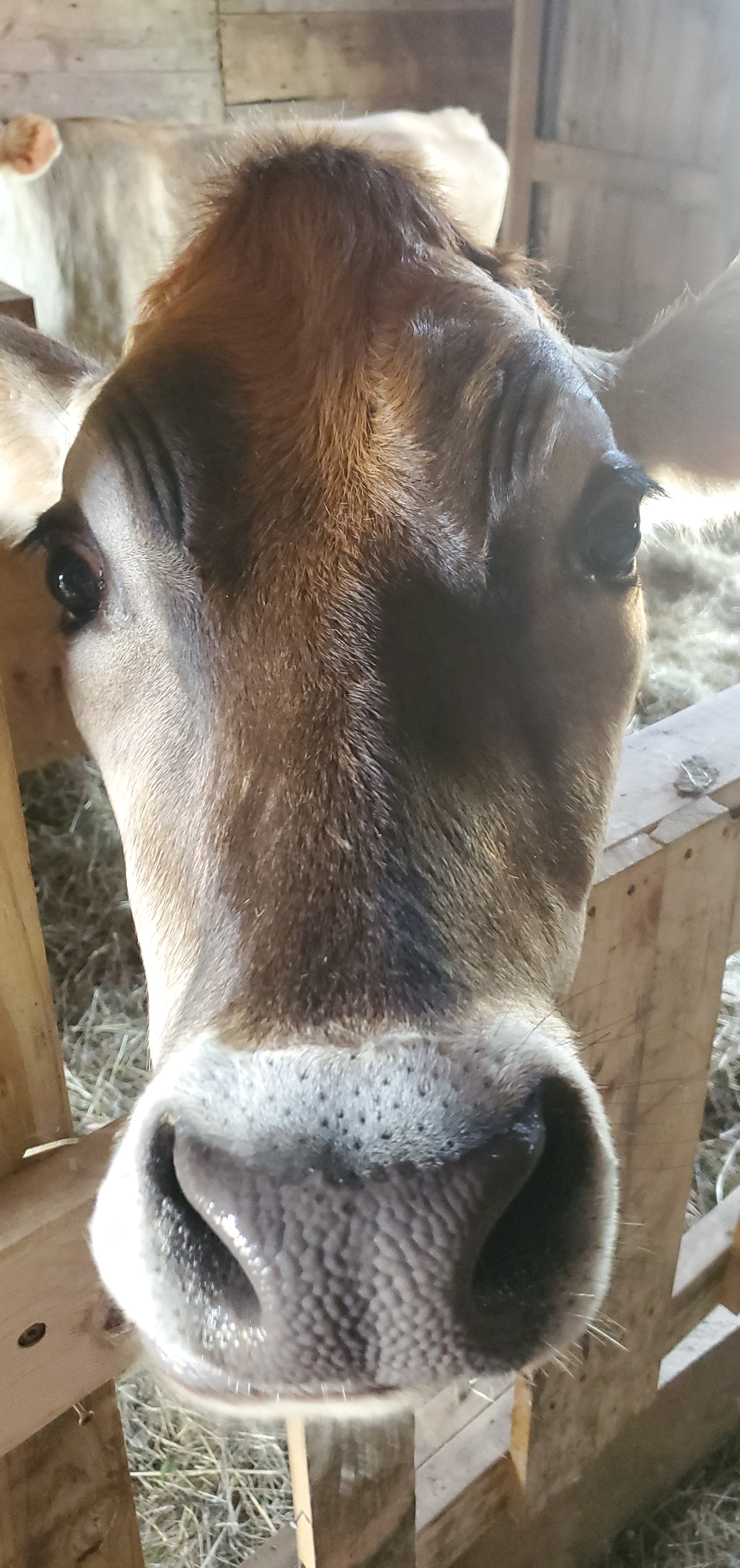
Daisy; bad trait of hers, if you give her half a chance, she will eat your shirt.
Meet Miss Daisy, she is a certified organic A2A2 Jersey! Daisy and I have gotten close over this past week, coincidentally I must add. She was recently bred for the first time, and we are hoping she is due to calve April 2024 so we can begin our milking journey together. Her and her 1/2 sister Rosie, are the first dairy cows on the farm since the government bought out the herd of Holsteins in the 1980’s, but that is a story for another day I suppose. Along with the commercial aspect of the farm, selling beef, chicken, and eggs to our thoughtful customers, our family has a mind for self-sustainability and homesteading. Daisy and Rosie were a welcome addition to provide us with A2A2 raw milk, and whatever other dairy products we commit to making from our harvest.
So, Daisy had to have had a false pregnancy, and much to our, and the vets surprise, actually started producing milk. This provided an opportunity for bacteria to enter into her udder and create an infection. This went unnoticed until her udder was too swollen to miss and I went investigating. I decided to try milking the rear quarter that looked large, and out came some milk and some strings, a sure fire sign of mastitis. I called my grandpa David, I had just heard his truck pull in from his long day of hauling hay, and I asked him to stop by to confirm what I was seeing to be true. He agreed on the symptoms seeming like mastitis, so I put a call in to the vet. After some deliberation we decided that just stripping the infected quarter 5-6x per day, for a week’s time should be enough to starve out the infection so it could clear itself up. At first he recommended a course of antibiotics but since the girls are organic I really wanted to try the natural way first.
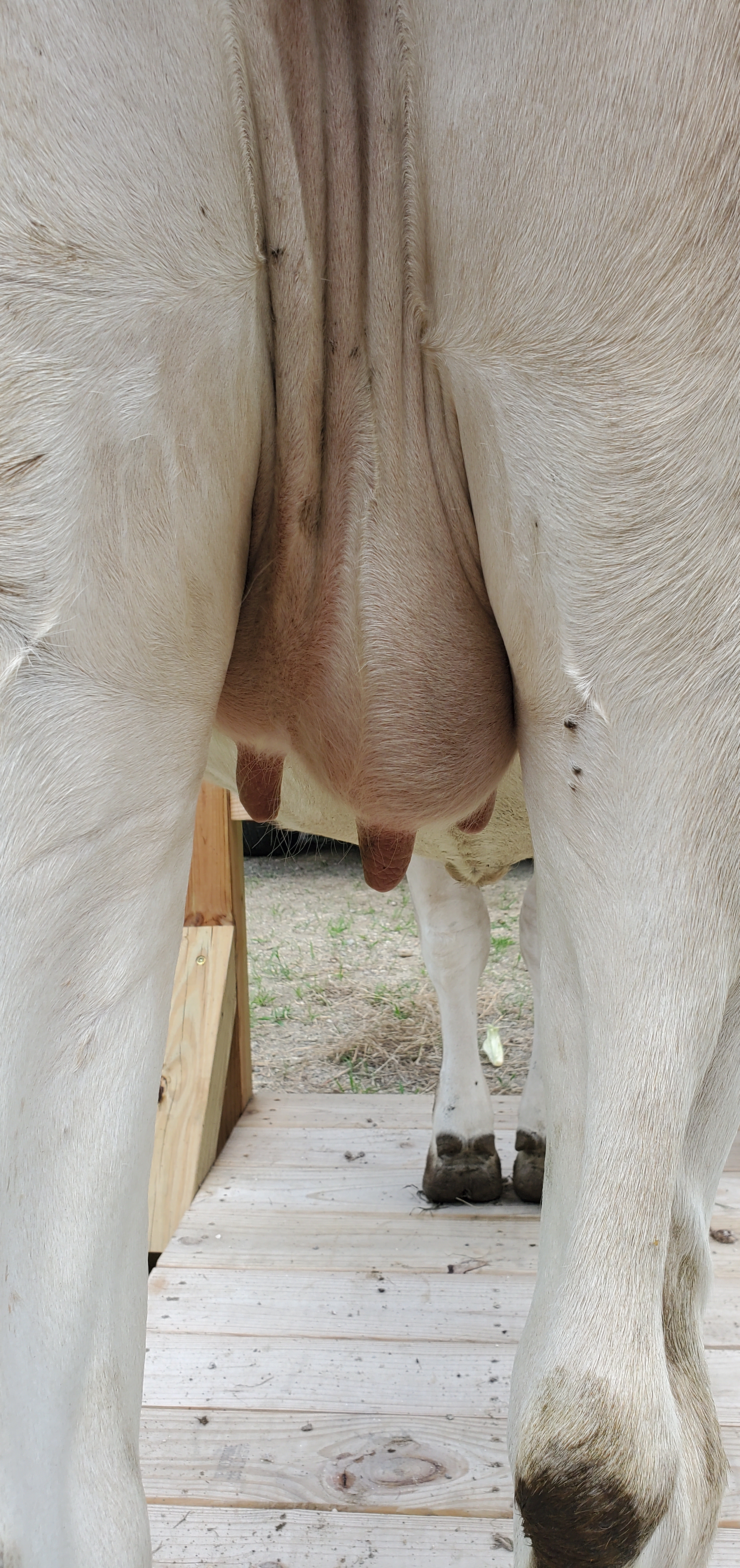
Day 1 – infected rear quarter.
Along with stripping Daisy I treated her with 2 doses of Vitamin C, one she ate the powder spread out on some apple slices, and the next higher dose we made an alfalfa pellet mush with a little honey on it, she gobbled that up too. Yesterday made a week and there are no more signs of mastitis. I am grateful of that, even she seems to be feeling better. When I turned them out to their pasture last night she was jumping and bucking and picking a play fight with Rosie, she hadn’t been doing that for a couple weeks.
Now when I first discovered the mastitis I immediately, once the kids where in bed, started researching mastitis, and came across some interesting studies that have been conducted recently. To summarize, the findings of mastitis’s antibiotic resistance are off the charts. When I asked the vet about this, he said he usually treats with 2 or 3 different ones at a time to increase the chance of getting the treatment to match the strain of bacteria causing the infection. When I asked about a natural way he didn’t blink twice before he recommended just keeping her stripped. I had also read a clinical study, to match the findings of a farmer’s experience, with high dose vitamins on livestock for treatment, specifically vitamin C. So, I decided to add this to the regiment, I’m not sure if it helped but I do know the infection is gone, and nobody is harmed by some extra vitamin C in their life. Also, interestingly enough, the antibiotic resistance is driving clinical studies of treatment alternatives from God’s green earth. Things such as vitamins and essential oils, which if we had just done in the first place we wouldn’t have the resistance occurring, and would could reserve the antibiotics for dire circumstances. As it sits, only 50% of mastitis even needs intervention at all.
This experience, like most others, had me learning and growing in things that I was unprepared for and was not expecting to face just yet. There are a few things that really helped me be successful. The first one being, doing my own research. We live in the age of information and most all scientific studies that your Vets and Doctors have access to, well we do too, so arm yourself with information. Be prepared to advocate for yourself or your animals, don’t just accept the status quo. The second one, being a mother and having had nurslings gave me a unique perspective as her caretaker. It helped me to tenderly, and somewhat more personally, tackle this situation to help her back to health. Three, after your toolbox is full of what you can put in it, through your own knowledge and research, see what others have in their toolbox. I called my grandfather, my mom, my cousin MacKenzie, who has experience from working a commercial dairy farm, and finally a vet, who did in fact welcome the my discourse and offer me practical advice on how to go a natural way. It won’t always go this way, and people won’t always welcome discourse, but I think as a society we would be much better off for it. After all, you can’t know what you don’t know.
In a study of development of health advisory service in organic herds, the dialogue between farmer, veterinarian and agricultural cattle advisor changed the treatment pattern markedly during a period of 6 months. Among important future challenges for veterinarians in organic farming is pointed at the constructive, open, and critical interaction with the single organic farmer as well as the organic animal husbandry system in general.
https://pubmed.ncbi.nlm.nih.gov/11995391/
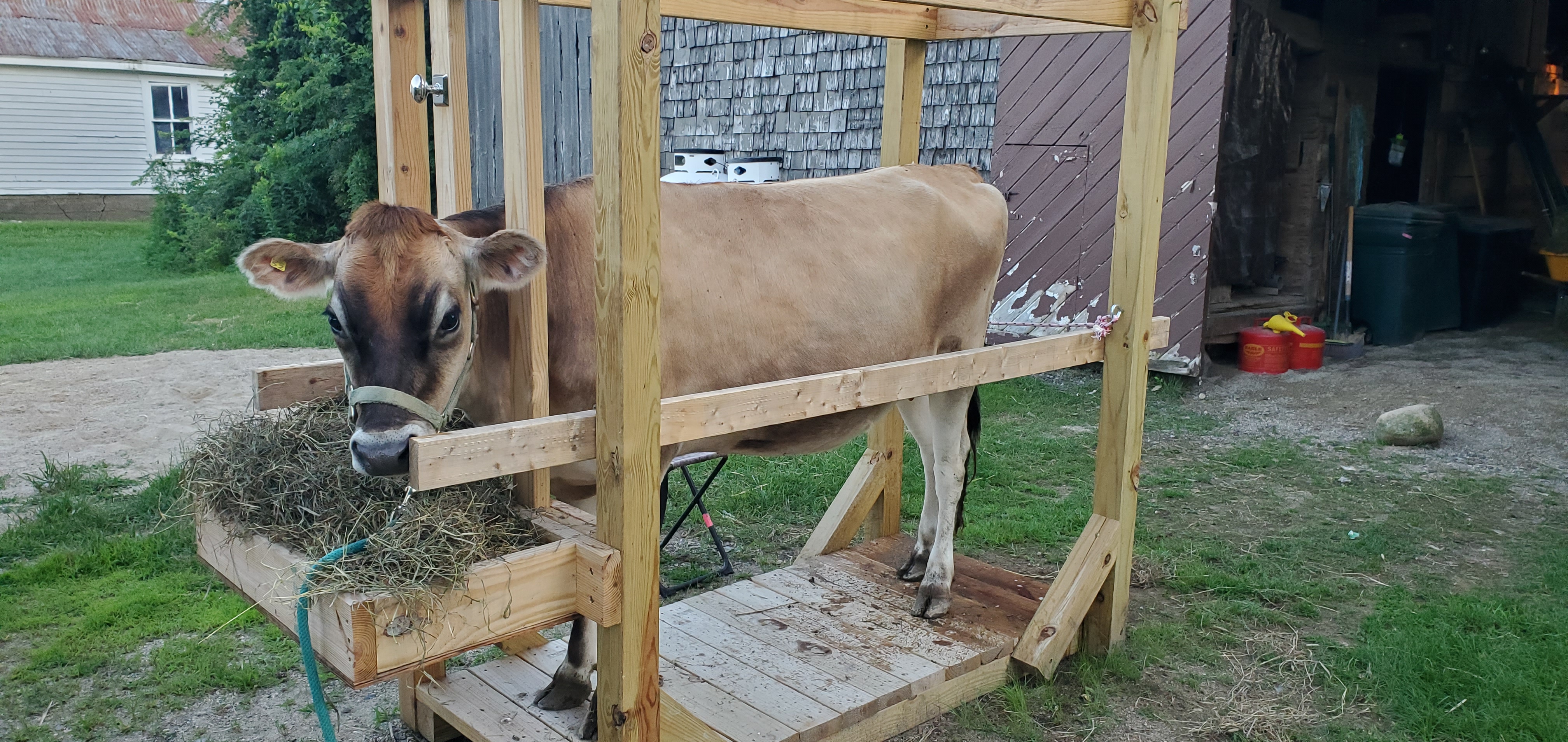
Daisy girl, she grew fond of our routine in just a short week, and was always looking for a reward for her cooperation.
Thank you for reading and be Blessed!
Lorin



 White's Farm